Apologies for the lack of last week's update but I was on holiday.
The good news however is that I've spotted plenty of new birds in the meantime.
New Port Wetlands (Newport, South Wales)
This is a fantastic reserve featuring both lakes and estuaries. Sadly, within 15 minutes of getting there the heavens opened, causing me to get soaked to the skin (fortunately my equipment seems okay). I spent most of my time in the visitors centre, but eventually made it to the hide. I managed to spot two new birds here.
Sedge Warbler
This migrant spends most of its time in Southern Africa, but likes to breed here during the Summer. I was lucky enough to get extremely close to this one before it flew off! It looks quite similar to the Aquatic Warbler, but it's distinctive eye stripe helps to distinguish it. The Aquatic is also much rarer. It's very common in the reedbeds of various wetlands, with over 260,000 birds breeding in the UK each year.
Little Grebe
The only other new bird I saw at Newport Wetlands was my second Grebe. I saw one feeding a youngster, while another was near the hide. Like the Great Crested Grebe, it's a diving bird, constantly heading underwater to look for new morsals to eat. It's relatively common compared to some of our other Grebes and is typically found on large stretches of water.
Here's a selection of some of the other birds I saw at the Wetlands.
House Sparrows were everywhere.
Goldfinch flying.
Greenfinch attracted to the feeders.
Grey Heron on the wing.
Another Little Grebe, this time at the hide.
Blue Tit on feeder.
Another Greenfinch.
Mid Wales
This is where I got most of my new birds. It's a beautiful part of Wales, very remote, where my sister recently bought 10 acres of land. She had lots of breeding birds from a few weeks earlier, so I was hoping to see a few for myself. I wasn't disappointed (well I was, because I didn't see a Dipper, but it was otherwise all good).
Buzzard
I always see Buzzards, but I'm normally driving when they appear, so I can never get a photo. I told my wife to stop the car and got this one as it was flying off, but if I realised how many I would have seen I wouldn't have bothered. Anyway, Buzzards are one of our most common large raptors with nearly 80,000 breeding pairs. They have a distinctive piercing call and typically holds its wings in a shallow v when soaring. They were constantly flying over the hills around my sisters house, but would rarely fly down low, meaning manner of my shots are from quite a way off.
This was the first Buzzard I saw, but it wouldn't be the last.
Shot using aperture, hence blurry wings.
More Buzzards on the wing.
Lesser Redpoll
I thought this was a Linnet at first, but members on the RSPB forum soon identified it for me.
Widespread in Wales, this was one of the many breeding birds that had been observed a few weeks previously. It's a delightful little thing, roughly Blue Tit size, with a unusual call. Like the Linnet it's a finch, and is commonly confused with the Mealy Redpoll (in fact until recently, they were considered the same bird). Sadly I couldn't get fantastic shots, so I guess I'll have to visit my sister's again :)
This is the best shot I could get.
Here's another, note the distinctive red cap.
And here's a female.
Redstart
This was one of my favourite spots at Kellie's a gorgeous little thrush that I've never seen before. Sadly this beautiful bird is now declining in most of the country, meaning remote places are your best chance of seeing one. It's an extremely colourful Thrush, with the male being identified by its striking orange breast and tail, which it often flicks. It's seen in the country from April to September and feeds on everything from spiders to berries.
Gorgeous bird. The breast is a dead giveaway.
The same bird. It moved over to some pines.
I'm pretty sure this is a juvenile. Again, note the orange tail.
Yellowhammer
This is my first Bunting and it's a gorgeous one. I saw a juvenile, meaning it lacks the brilliant yellow head and breast of a fully grown male. Although there are 710,000 breeding pairs, the RSPB has this down on the Red List, meaning its numbers have declined rapidly in recent years. It's best known for its song which sounds like "a little bit of bread and no cheese" and can be found all the year round throughout most of the UK. It's often confused with the rarer Cirl Bunting.
Unfortunately, this was the only Yellowhammer I saw.
Whinchat
Like the Redstart this is another Summer visitor and another that's in decline. It's quite similar to the Stonechat and frequents similar environments. The large white stripe on its head helps it to stand out from its cousin though. There are around 47,000 breeding pairs and is found from April to September. I saw this one on a nearby telephone wire a short distance from the Yellowhammer.
Red Kite
After being told that Red Kites had been nesting in my sister's back garden I was really looking forward to seeing some. They're massively impressive birds, being bigger than Buzzards, with wingspans up to five feet. They're immediately recognisable in flight thanks to their forked tails and thin wings. It's been a big success story for the RSPB where it has been brought back from near extinction. Once upon a time it was found everywhere, happily scavenging in the streets of London, but pesticides and egg collecting saw it retreating to Wales, where its numbers were dangerously low. It's now found in various parts of the UK and has even been spotted in my neck of the woods. A beautiful bird of prey that's truly graceful in flight.
It almost looks like a giant Swallow. Almost...
Goldcrest
Alongside the Firecrest, this is the UK's smallest bird, typically being under 4 inches in length. While it can be found throughout the UK it's a big fan of pine trees where it forages for small insects. As many as 5 million birds winter here, with breeding pairs numbering some 610,000. As a result it's one of the least concerned birds on the RSPB's list. I think this one is a juvenile, as it looks a bit drabber than a typical adult.
It's small size made it tricky to focus on.
It looks quite scruffy as it had been raining.
It's smaller than a Wren. It's tiny.
Tree Pipit
I saw vast numbers of Meadow Pipits while in Wales, but I still saw quite a few of its cousin the Tree Pipit. Although there are 88,000 breeding pairs they are still on the RSPB red list. Unlike the more sociable Meadow Pipit, Tree Pipits tend to be found in smaller gatherings. They are identifiable by their hind claws, which are shorter than a Meadow Pipit's. They also have very different calls, which is how I was able to tell them apart.
Not the greatest of shots, meaning I'll have to get another!
There were plenty more birds that I'd already seen, but I'll still put up pictures :)
Meadow Pipit.
Treecreeper sunning itself.
Skylark.
Swallow.
Swallows.
Baby Blue Tit.
Baby Great Tit.
One of Kellie's chickens.
Dunnock.
Ram.
Willow Warbler
Willow Warbler again
ChiffChaff apparently.
Blackbird.
Siskin.
Flying Swallow.
Wren.
Stonechat.
Chaffinch.
Coal Tit.
More Swallows gathering for migration.
Robin.
Another flying Swallow.
Another Wren.
Linnet.
Young Meadow Pipit.
Ham Wall, Somerset
After visiting my sisters we travelled down to Somerset. I was hoping to see a Great White Egret and Bittern, as Ham Well was one of the few places in the UK where both could be seen. Upon getting there it was raining and continued to run for the next 1 and 20 minutes. I only had a total of two hours while the wife and kids went shopping. I'd already been told by a fellow bird watcher that work on the reserve had scared off both birds, and was told I had wasted my journey. It's a good job I rarely listen to people...
Great White Egret
Along with the Red Kite, this is one of the birds I was most looking forward to seeing. It's a fantastic creature, roughly the same size as a Grey Heron and incredibly elegant to look at. Unfortunately, it was pretty far off and I'd forgotten my SX50, but I was still pleased with the pictures. They are very much like oversized Little Egrets, but with yellow bills. The birds at Ham Well are apparently breeding, but they remain incredibly rare, with around 40 sightings in the UK each year. Needless to say, seeing one on the off chance was amazingly fortuitous.
Framed by Mute Swans so you can get a sense of its size.
Another shot, this one cropped.
And a drizzly shot of it in flight.
It's a massive bird with a slow deliberate flight.
Marsh Harrier
I always miss Marsh Harriers when I go to Radipole Lake. And I nearly missed these ones. This is the UK's largest Harrier, with the female being bigger than the male. It's another bird on the amber list, wwith less than 380 breeding pairs dotted throughout the UK. It's well known for the aerial dance it does where the male tosses food to the female who cartwheels and catches it in mid air. But I wasn't going to see that. Was I?
It's only resident in one area of the country, being a Summer visitor to places like Ham Wall and Radipole Lake.
Here's the Marsh Harrier, a good way out.
All of a sudden he's joined by another bird. Is it getting mobbed?
Nope it's a pair, ready to play toss the mammal.
And it's a successful catch!
And like an idiot I've used aperture, meaning the pics aren't that sharp. Doh!
Bittern
After seeing the Great White Egret and the spectacular Marsh Harrier dance I was feeling lucky. But would my luck hold out? It certainly did, and as I left one of the hides a Bittern decided to come in for a crash landing. It's an extremely rare and hard to see heron that is more likely heard than seen. It has a big booming call that it uses to attract a female and likes to stay hidden in the dense reed beds where it makes its home. It's on the red list and typically found in the southern-most parts of England and Wales. It's a resident in only a few areas of the UK, typically wintering in most of parts of the country. There are thought to be as few as 80 breeding pairs in the UK.
Cropped shot of Bittern.
And another to show how far off it was.
In addition to those three new birds I saw plenty of others...
Cormorant.
Cormorants fighting.
A Roe Deer?
A young Coot.
Grey heron.
Little Egret.
Great Crested Grebe.
Lapwings.
Little Grebe.
Mallards, Coots and a Grey Heron.
Mute Swans and Little Egret.
Great White Egret fishing.
Bodmin, Land's End, Cornwall
The last leg of our trip was Cornwall. While we were visiting friends, it was a good chance to check out the local bird life as well. The trip didn't disappoint, thanks to a decent number of sea birds.
Shag
There were lots of Cormorants at St Michael's Mount, but I didn't see any Shags there. I had more luck at Land's End, when the following was identified as one. They are extremely similar to Cormorants, but are a little sleeker with lighter bills. The adults lack the big white cheeks as well. They're another endangered bird, appearing on the RSPB's Amber List and there are around 27,000 breeding pairs.
Not the greatest shots as they were hundreds of feet out.
Fulmar
It's easy to think of the Fulmar as a gull but it's actually closely related to Albatrosses. Unlike gulls, Fulmars tend to glide, rather than flap their wings, making them a lot more easier to identify. They can also be recognised by their bulky beaks that enable them to squirt out a foul oil as a defence mechanism. They like to spend their time at sea, but will alight on rocks to nest during the breeding season.
Here it's easy to see the Albatross like eyes and bulky beak.
And a better shot as it flies away!
Gannet
I've heard tales of spectacular Gannet colonies and how they dive into water to catch fish. Sadly I saw neither, so I'll need to book a trip to somewhere suitable next year. They're another migrant, appearing in early January and staying as late as October. There are around 220,000 breeding pairs, but their limited locations mean they are on the RSPB's Ambre list. They're beautiful birds with a cigar shaped body, powerful wings and bright yellow heads. They're related to Boobies and are renowned for their spectacular diving acrobatics.
Hopefully I'll get some closer shots next year!
Stock Dove
It wasn't all seabird hunting and I was lucky enough to spot this Stock Dove when we went to one of Cornwall's delightful country parks. It's similar to a Wood Pigeon, but it's easy to tell apart as it misses the white ring around the neck and has what I call dead eyes (like a shark's eyes). They can be found in all sorts of environments, from parks to cliff tops, making them extremely diverse birds. Just like Feral Pigeons, to which they are related.
A shot in poor light, but you can clearly see the dead eyes. Creepy!
Sanderling
I saw a lot of waders, but many of them were Redshanks, Ringed Plovers, Dunlins and Common Sandpipers, all birds I've already seen before. Luckily I did got one on the shores of St Michael's Mount. The Sanderling is another tiny wader and one that doesn't breed in the UK. It's often confused with the Knot and is about the size of a Dunlin, but lacks the Dunlin's black breast. Around 17,000 birds winter here each year and feeds on numerous small molluscs and invertebrates.
Of course I saw lots of other birds in Cornwall. Here's some of the more notable ones.
A Common Sandpiper looks for a snack.
A Dunlin rests at St Michael's Mount.
A juvenile Redshank looks for food.
While everyone else looks on.
Buzzards were everywhere. This one kept flying off whenever I tried to get a photo.
And he's off again.
Don't take photos in moving cars!
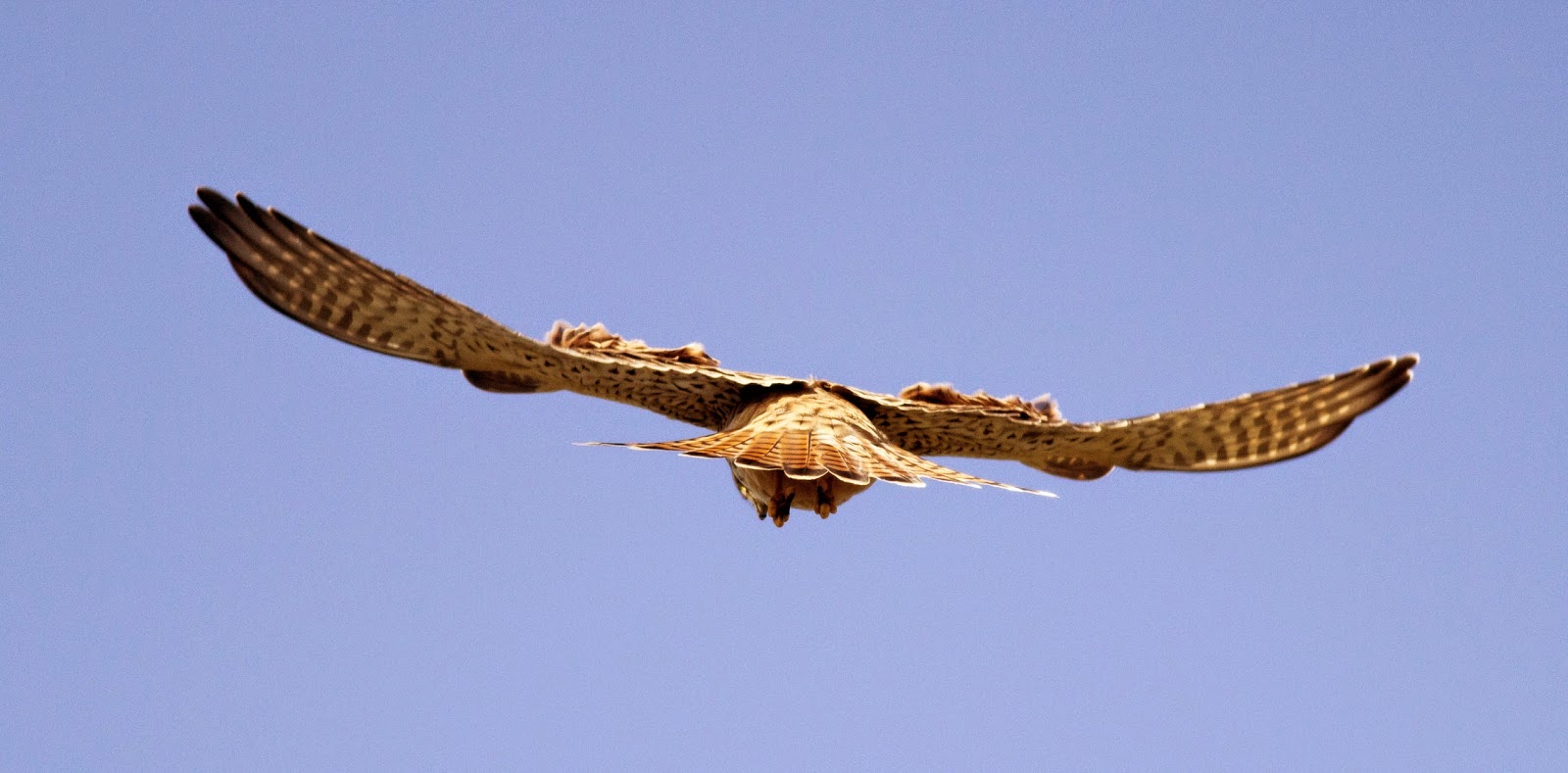
This Kestral made the £5 car park at Land's End worth it.
Makes a kill.
On patrol.
Hovering.
More hovering.
And Strike!
Herring Gull flyby.
Rooks were everywhere.
As were Jackdaws.
Black-Headed Gulls were plentiful.
And so were Collard Doves.
A Mallard preening.
A skinny Carrion Crow or a Magpie?
Crazy shot of the moon.
More Jackdaws.
Gulls were everywhere.
Some metal bird...
St Michael's Mount.
Oystercatchers.
Ringed Plover
Dunlin
I'm not too hot on Butterflies.
Some type of gull.
Egrets at Marazion Marsh, another RSPB reserve.
Mute Swan with the family.
A juvenile Grey Heron
And we're done. So that was one massive update. Well done if you stuck all the way through it. I'm now at 102 birds! with another 170 left to find. It's going to get a lot tougher now!