Showing posts with label greylag goose. Show all posts

Sunday, 10 January 2016

Patchwork Challenge - Visit 2 (09-01-2016)


I didn't have a lot of time today, but did manage to add a few new birds to my patch list for the Patchwork Challenge. I hurried around the North lake only as the weather was looking poor and I was concerned about getting my big lens wet. It wasn't too bad a day, although frustratingly I left my binoculars at home, meaning I couldn't identify a lot of birds.

It was pretty much business as usual on the lakes, with Tufted Ducks, Pochards, Mallards, Gadwell, Little Grebe, Crested Grebe and Coot all making an appearance. Interestingly, I've seen no Moorhens yet, which seems odd, but I'll keep looking for them. I did spot a few additional ducks this time around, finding a small group of Shoveler on the South Lake Island and Teal dabbling about in the Hampreston Fields.


Female Shoveler to the left and a male Gadwell to the right.

Speaking of Hampreston Fields there was still a lot of action there. The Mute Swans and Canada Geese were still present, but I was also able to add Greylag Geese to my list, which was nice. Unfortunately, I'd left my camera on -2 exposure so the following shot isn't the best.


This was very distant, but doesn't look too bad.


There was a large number of Canada geese present.

I continued to scan the fields and added quite a few Corvids to the list, including Carrion Crows, Jackdaws and about 6 magpies. There was a large flock of around 30 Rooks too, adding another new bird to the patch list. Starlings were also busy, looking for food with the Rooks, so that was another tick to the patch too.

In addition to scanning the waterlogged fields for rare geese (you never know right?) I was also looking for gulls, particularly Common Gulls which are quite common here. I did see plenty of Black-Headed Gulls and a few Herring Gulls but no Common Gulls. Apparently, one of the Herring Gulls was a Northern Scandinavian one, but as far as I know it's not worth extra points. Plenty of gulls have been sighted at the lakes, so I still have time to find some rare ones.


Herring Gulls, the one of the left is the Northern Scandinavian one.

One thing I am lucking out on is passerines. Things got off to a great start with a small group of Great Tits in the car park, but I was less lucky walking around the lakes. I heard plenty of birds, but I'd not trust my ID too identify them by sound alone. I saw plenty of Blackbirds, a few Blue Tits and quite a few Goldfinch, but there were no birds in large numbers. I saw a few more Long Tailed Tits, but the Redwings were nowhere to be seen this time around. Still, I did manage to find a small group of Greenfinch and a lone Pied Wagtail, which gave me two new birds.

The only other new bird this week were two buzzards, which I saw separately, both flying in the same direction. I didn't see any other raptors, although I vainly (and probably, foolishly) scanned the famer's field for barn owls and short-eared owls.

That now brings my patch total to 33 birds, which is way short of what I'd like, but not too bad considering my lack of obvious species like Robin, Dunnock, House Sparrow and several other birds I should have seen by now.

What follows will be a list of every different bird I saw that day, but we'll finish with a shot of a Cormorant :)


Black-Headed Gull
Blackbird
Buzzard
Carrion Crow
Canada Goose
Coot
Cormorant
Gadwell
Goldfinch
Great Crested Grebe
Greylag Goose
Green Finch
Great Tit
Jackdaw
Little Grebe
Long-Tailed Tit
Magpie
Mallard
Pied Wagtail
Pochard
Rook
Shoveler
Starling
Teal
Tufted Duck
Wood Pigeon

Sunday, 1 June 2014

Week 7 01-06-2014 Birds Spotted 3


Hooray, after a miserable week last week, I've now got three more birds to add to the collection.
Before we take a look at them, let's talk about the British weather and why it's a bit rubbish for bird watching. As you may have noticed, we don't have the greatest of weather in the UK, with everything tending to be tinged with a naff shade of grey.

It becomes a big issue for bird photography as you're trying to collect as much light as possible. If it's not there your pictures can often look very drab and miserable. I'll be looking at ways to combat this going forward, so expect updated pictures of birds in my main Flickr Album as I get them.

While you can't always guarantee what birds you're going to see, you can up your chances by visiting places you know certain species are going to be. One such location is Poole Park in Poole, Dorset. It's a great location as it has both seawater and freshwater and attracts a fair number of different species. Unfortunately, many of the birds there I have already seen, but I did manage to pick up a few new additions.

So anyway, let's take a look at the birds that flew past my lens this week.

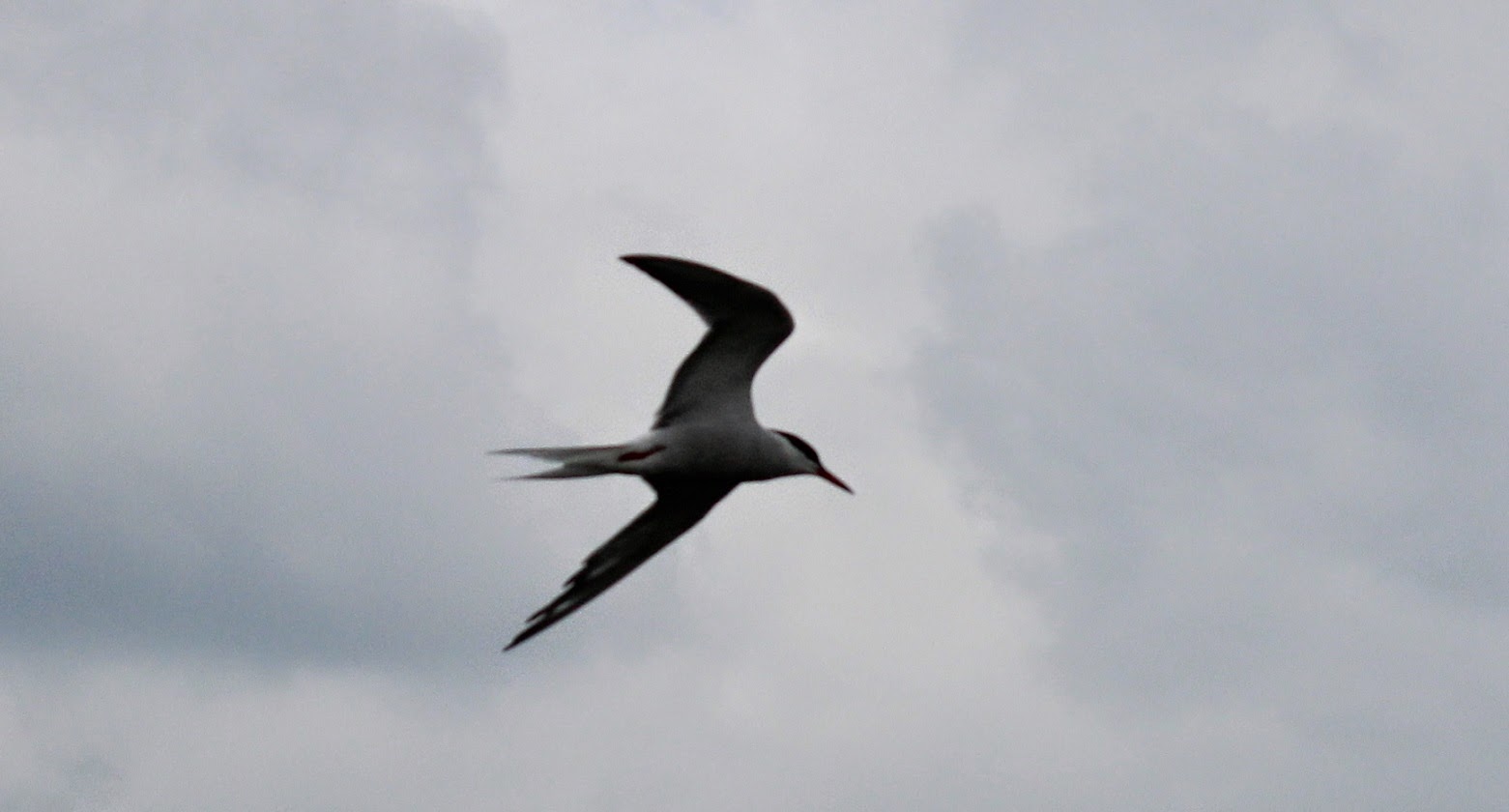
Common Tern
I spotted this little fellow on my entry into the park. He was a creature of habit, slowly circling one of the smaller estuaries while looking for tasty fish to eat. The best shot I managed to get of him was the first one I took, and it's annoying that it's so overcast as you can't really appreciate what a beautiful looking bird it is. It's very similar in size and colouration to the Artic Tern, but has a black tip to its bill instead of being completely red. It's a summer resident, arriving around April and heading off home in August/September, but does breed in the UK. In fact there are around 12,000 breeding pairs every year. It's a truly beautiful bird in flight and while it's not as acrobatic as a hummingbird it's arguably as graceful and as nimble as a Swallow. We watched him for a good ten minutes and he managed to catch quite a few fish in that time.


Note the long ways and Swallow-like tail.

Curse our miserable UK weather.


Greylag Geese
Poole Park is swarming with Greylag Geese, the little beggars are everywhere and currently breeding, so you can't walk anywhere without upsetting a nearby parent. Many of the goslings are at different stages of development and they make for quite a site as you walk around the park. In total I spotted around 100 babies in total, although it's possible there were more.
Most common domesticated geese are related to this goose and it's largely domesticated itself in most parts of the UK. Wild breeding birds are typically found north and in Scotland where they gather in surprisingly large numbers. Greylag Geese are our largest native goose and will hiss if you get too close to them. They were very protective of their young, chasing after my daughter when she got a little too close for comfort.
They may be completely grey, but Greylags do have some nice markings to them.

It's impossible to tell who's with who here.

So use are they to man, you can get nice and close.

As you can see these young are slightly older than the others.

Stone Chat
The final bird I saw this week was a Stone Chat, which I spotted while taking a walk over at Arne Nature Reserve. It gets its name because its song sounds like two rocks smacking together, and not because it can talk to stones and other inanimate objects. Jokes aside, it's a very pretty bird, although you can't tell this from the poor lighting I shot this male in. It has an orange breast similar to a Robin and is quite similar in size. It's also related to the popular Robin and is usually confused with the similar looking Winchat. I was lucky enough to come across an entire family of these delightful looking birds, who were only too happy to hide behind gorse bushes, ensuring I picked up plenty of scratches in my quest to photograph them.
This is a male Stone Chat, the lighting isn't great, but you can see his orange belly here.

Not the greatest of shots thanks to my lens, but this is a female.

And here's a juvenile that I was able to get quite close to before it flew off.

So that's it for another week. While it's been pointed out to me that Peregrine Falcons are nesting near my work, I've so far not seen them. I'll be popping off during my lunchtimes this week, so with any luck I'll be able to add at least one new bird to the list next week. That brings my current total to 54 birds spotted with another 218 left to find. If anyone would like to recommend good places to go spotting I can be found on the RSPB forum under the name Darran J.