Showing posts with label canon. Show all posts

Sunday, 8 June 2014

Week 8 08-06-2014 Birds Spotted 1

It was another relatively quiet week for new birds, but a great week all the same for capturing interesting specimens through my lens. This is going to be my last blog before I upgrade to a new lens. I've deliberated hard about which one to go for, but the Canon 400mm prime looks to be the most sensible choice for me. I've grown quite fond of taking bird in flight shots, and this particular Canon is much better than the zoom equivalent. You'll hopefully see an upgrade in my images very soon.

In the meantime lets take a look at what happened this week. In fact, let's look at the one new bird I saw.

Green Woodpecker
What an amazing looking bird. We went to Queen's Park Golf Course as I've often seen this gorgeous looking birds there in the past. They love flying down onto the greens where they have easy access to insects and can be quite hard to see due to their colouring. After hanging around the large pond there we walked off-course and eventually spotted one quite some way off in the distance. While they are immediately striking with their bright green plumage and red heads, it's their brilliant laughing calls that really give them away. This one was clearly excited as it was making quite a lot of noise. My first shot wasn't great as he was far away and on the ground, I was lucky enough to get a nice shot of it in flight though. Woodpeckers have bounding flight paths that can make them quite tricky to shoot, so I'm quite pleased with the way it eventually turned out. Also known as the yaffle (due to its laughing call) the Green Woodpecker is our largest woodpecker with over 52,000 breeding pairs. It's always nice when you go out with the hope of seeing something and have it actually happen and while it was the only new bird I spotted this week it was certainly worth seeing.

As you can see, they're well camouflaged when they are on the ground.

And here he is in flight, look at the gorgeous patterns on the wings.

So I only saw one bird this week, which puts my grand total on 55 birds, with just 217 left to spot. A near miss this week included a Bullfinch. I got a photo, but it's terrible quality, so I won't be including it here. Maybe I'll get it next week, along with that pesky Peregrine.

So to finish off this week here's a selection of birds and insects that I saw while visiting the pond and the Throop part of the river Stour.

Even the most mundane birds look great in flight, as this Black-Headed Gull proves.

There were a family of Mallards at the pond. Lovely.

They weren't keen on getting wet though.

You certainly don't expect to see 10-inch Terrapins in the UK!

A male Mallard showing off.

A Mistle Thrush in flight.

The obligatory Robin shot.

A resting Damselfly.

A Black-Headed Gull splashes down.

A male Moorhen looking out for his chicks.

He got chased off by a duck though.

Annoyingly this Grey Heron was in a very shaded and dark area.
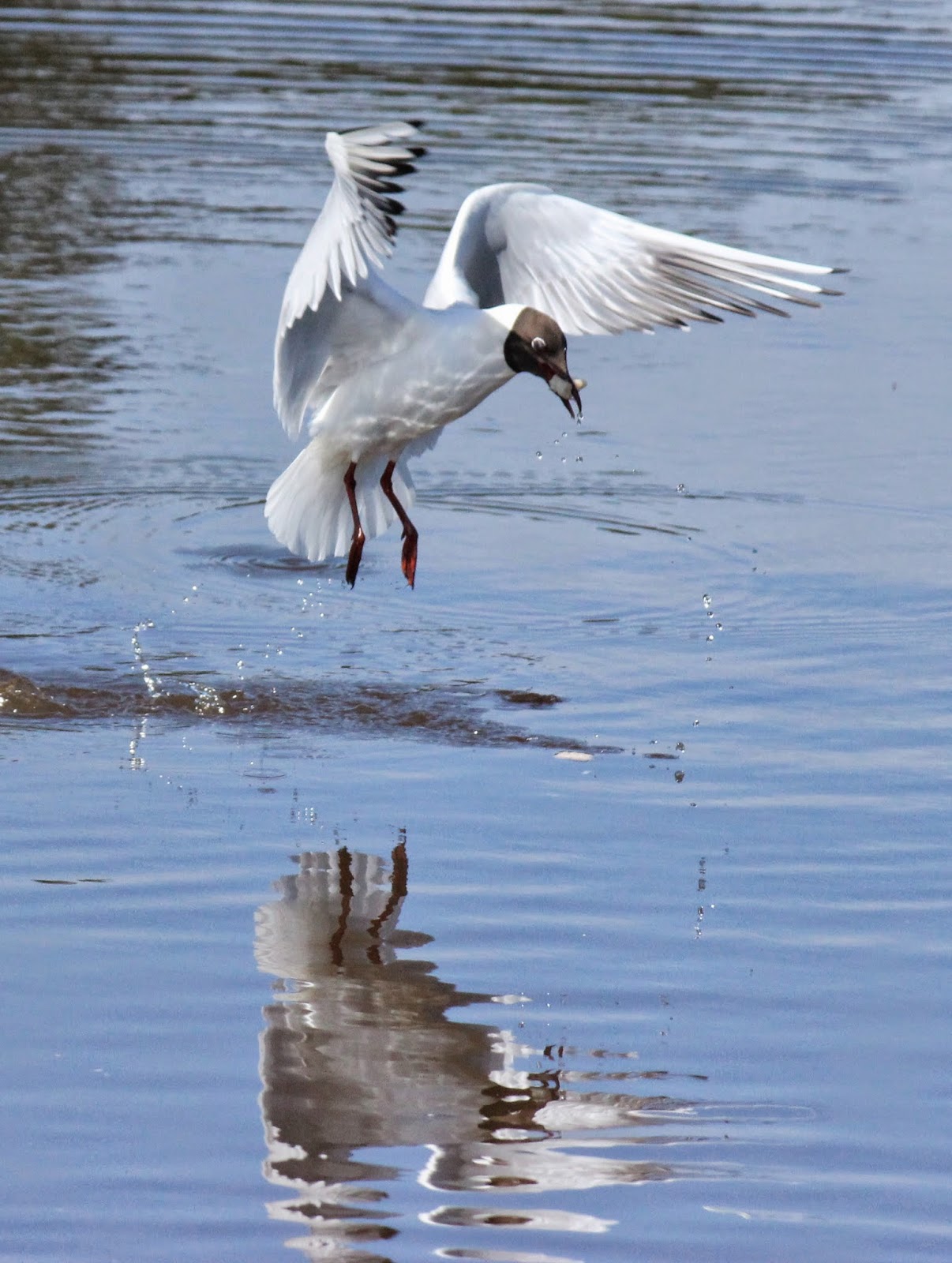
An opportunistic Black-Headed Gull.

I don't recognise this Damselfly, but it had a strange fluttering flight like a Butterfly.

A very tatty Red Admiral.

Hungry fish!

Hoverfly.

A final Black-Headed Gull flyover.

Sunday, 1 June 2014

Week 7 01-06-2014 Birds Spotted 3


Hooray, after a miserable week last week, I've now got three more birds to add to the collection.
Before we take a look at them, let's talk about the British weather and why it's a bit rubbish for bird watching. As you may have noticed, we don't have the greatest of weather in the UK, with everything tending to be tinged with a naff shade of grey.

It becomes a big issue for bird photography as you're trying to collect as much light as possible. If it's not there your pictures can often look very drab and miserable. I'll be looking at ways to combat this going forward, so expect updated pictures of birds in my main Flickr Album as I get them.

While you can't always guarantee what birds you're going to see, you can up your chances by visiting places you know certain species are going to be. One such location is Poole Park in Poole, Dorset. It's a great location as it has both seawater and freshwater and attracts a fair number of different species. Unfortunately, many of the birds there I have already seen, but I did manage to pick up a few new additions.

So anyway, let's take a look at the birds that flew past my lens this week.

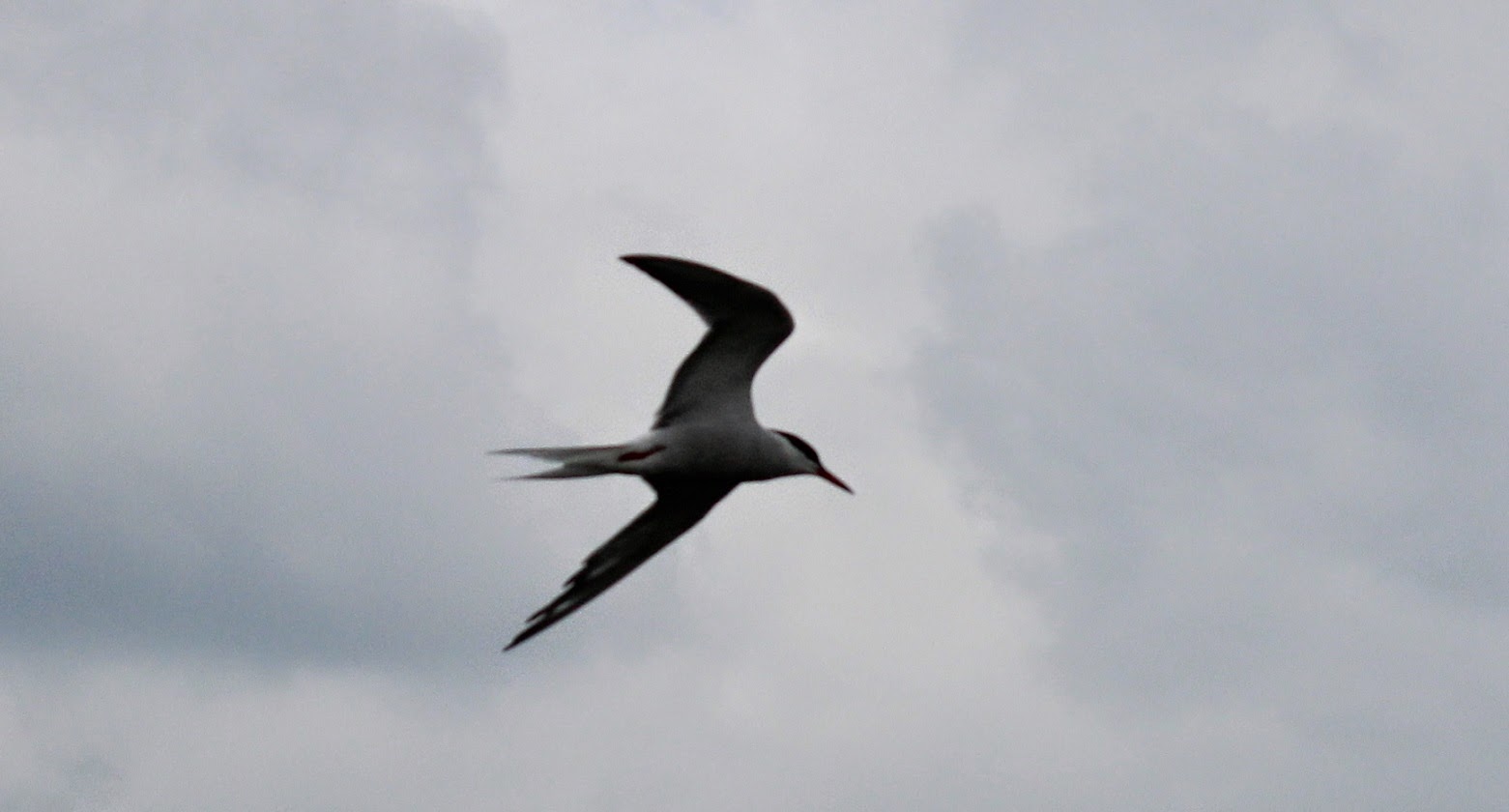
Common Tern
I spotted this little fellow on my entry into the park. He was a creature of habit, slowly circling one of the smaller estuaries while looking for tasty fish to eat. The best shot I managed to get of him was the first one I took, and it's annoying that it's so overcast as you can't really appreciate what a beautiful looking bird it is. It's very similar in size and colouration to the Artic Tern, but has a black tip to its bill instead of being completely red. It's a summer resident, arriving around April and heading off home in August/September, but does breed in the UK. In fact there are around 12,000 breeding pairs every year. It's a truly beautiful bird in flight and while it's not as acrobatic as a hummingbird it's arguably as graceful and as nimble as a Swallow. We watched him for a good ten minutes and he managed to catch quite a few fish in that time.


Note the long ways and Swallow-like tail.

Curse our miserable UK weather.


Greylag Geese
Poole Park is swarming with Greylag Geese, the little beggars are everywhere and currently breeding, so you can't walk anywhere without upsetting a nearby parent. Many of the goslings are at different stages of development and they make for quite a site as you walk around the park. In total I spotted around 100 babies in total, although it's possible there were more.
Most common domesticated geese are related to this goose and it's largely domesticated itself in most parts of the UK. Wild breeding birds are typically found north and in Scotland where they gather in surprisingly large numbers. Greylag Geese are our largest native goose and will hiss if you get too close to them. They were very protective of their young, chasing after my daughter when she got a little too close for comfort.
They may be completely grey, but Greylags do have some nice markings to them.

It's impossible to tell who's with who here.

So use are they to man, you can get nice and close.

As you can see these young are slightly older than the others.

Stone Chat
The final bird I saw this week was a Stone Chat, which I spotted while taking a walk over at Arne Nature Reserve. It gets its name because its song sounds like two rocks smacking together, and not because it can talk to stones and other inanimate objects. Jokes aside, it's a very pretty bird, although you can't tell this from the poor lighting I shot this male in. It has an orange breast similar to a Robin and is quite similar in size. It's also related to the popular Robin and is usually confused with the similar looking Winchat. I was lucky enough to come across an entire family of these delightful looking birds, who were only too happy to hide behind gorse bushes, ensuring I picked up plenty of scratches in my quest to photograph them.
This is a male Stone Chat, the lighting isn't great, but you can see his orange belly here.

Not the greatest of shots thanks to my lens, but this is a female.

And here's a juvenile that I was able to get quite close to before it flew off.

So that's it for another week. While it's been pointed out to me that Peregrine Falcons are nesting near my work, I've so far not seen them. I'll be popping off during my lunchtimes this week, so with any luck I'll be able to add at least one new bird to the list next week. That brings my current total to 54 birds spotted with another 218 left to find. If anyone would like to recommend good places to go spotting I can be found on the RSPB forum under the name Darran J.

Sunday, 25 May 2014

Week 6 25-05-2014 Birds Spotted 0


Well it was inevitably going to happen. I only really get weekends to go out and take photos and this week family duties called. As a result I won't have any new species to share with you. Instead I thought I talk a bit about some of my favourite stomping grounds that I like to visit.

Arne Nature Reserve is based up on the peninsula overlooking Poole harbour. It's a fantastic place to look for birds, and while I've been there several times now, there are plenty of species that continue to elude me there. The great thing about Arne is its sheer variety. While it's predominantly heathland, there are also stretches of forest, pastures, bog land and even a small private beach - in short it's a lovely secluded paradise which is home to a lot of rare and uncommon species, most notable the Dartford Warbler.

It's manned by a group of friendly rangers, and while they're obviously there to sign up new members and care for the reserve, they're always a pleasure to speak to. The same can be said for those that visit the area. The average age of a bird watcher is around 42. As a result they tend to be a lot more mature and friendlier, only too happy to fill you in on the birds they've seen or point out the ones you've missed. This last point is quite interesting, as though bird watchers are a friendly bunch - at least the ones I've met - they're also competitive taking great glee in knowing they've seen birds you haven't. It's swings and roundabouts though, as it's impossible for everyone to see everything. It's usually harmless fun and I've already been told about plenty of great places to visit going forward.

I've been to Arne three times now and every time I've discovered surprises. From having a Sika Deer run out mere feet in front of me, to coming across a group of breeding dragonfly, there's always something of interest to see there. The following images will hopefully highlight both the diversity of the nature and flora found at Arne. Of course the real beauty of this blog (at least for myself) is even if I don't see any new birds, I always have a satisfying time.

This beautiful Sika Deer run out in front of me at one of Arne's hides.

Shelduck are plentiful at Arne, which is great as they're one of my favourite ducks.

If I hadn't been with the girls I may have stuck around to see what lived in this hole.

There's a nice secluded beach which offers a great view of the nearby islands.

An ant nest. They were big blighters as well.

Saw this white deer running with a herd of Sika.

Deer are quick and fleeting, so get shots while you can.

Feeders are a great way to get closer to birds.

So that's it for another week. Quite disappointing but that's the nature of wildlife photography, you never know when you're going to see something. So here's exhibit A, a sneaky Red Fox that walked past my house as I was saying good by to some friends. See you next week.


Friday, 23 May 2014

Birds In Flight


There's something amazingly graceful about birds in flight (or Bif as bird photographers call them). I've been practising taking photos of birds for the last couple of weeks and am finally getting to a stage where I feel comfortable with the end results. I'm not into the photoshop side of things yet (which I'm aware you really need to use to make your images pop) but I'm more concerned at the moment with just having a eye for what makes a interesting shot.

Birds can be gracefully, powerful and elegant, but they always look astonishing when you really look at them in flight and realise just how impressive they are. Whether it's a heron beating across a pond with measured deliberate strokes, or a skittish warbler flitting from tree to tree, I can watch them for hours.

Here's some of my more recent attempts at capturing birds in flight. Hopefully, once I'm able to get my hands on the Canon 400mm lens I'll be able to take even more impressive images.

An early shot I took of a Carrion Crow. This was taken at Hengistbury Head.

I thought this was a Mediterrranean Gull, but it's the more common Black-Headed Gull. Oh well.

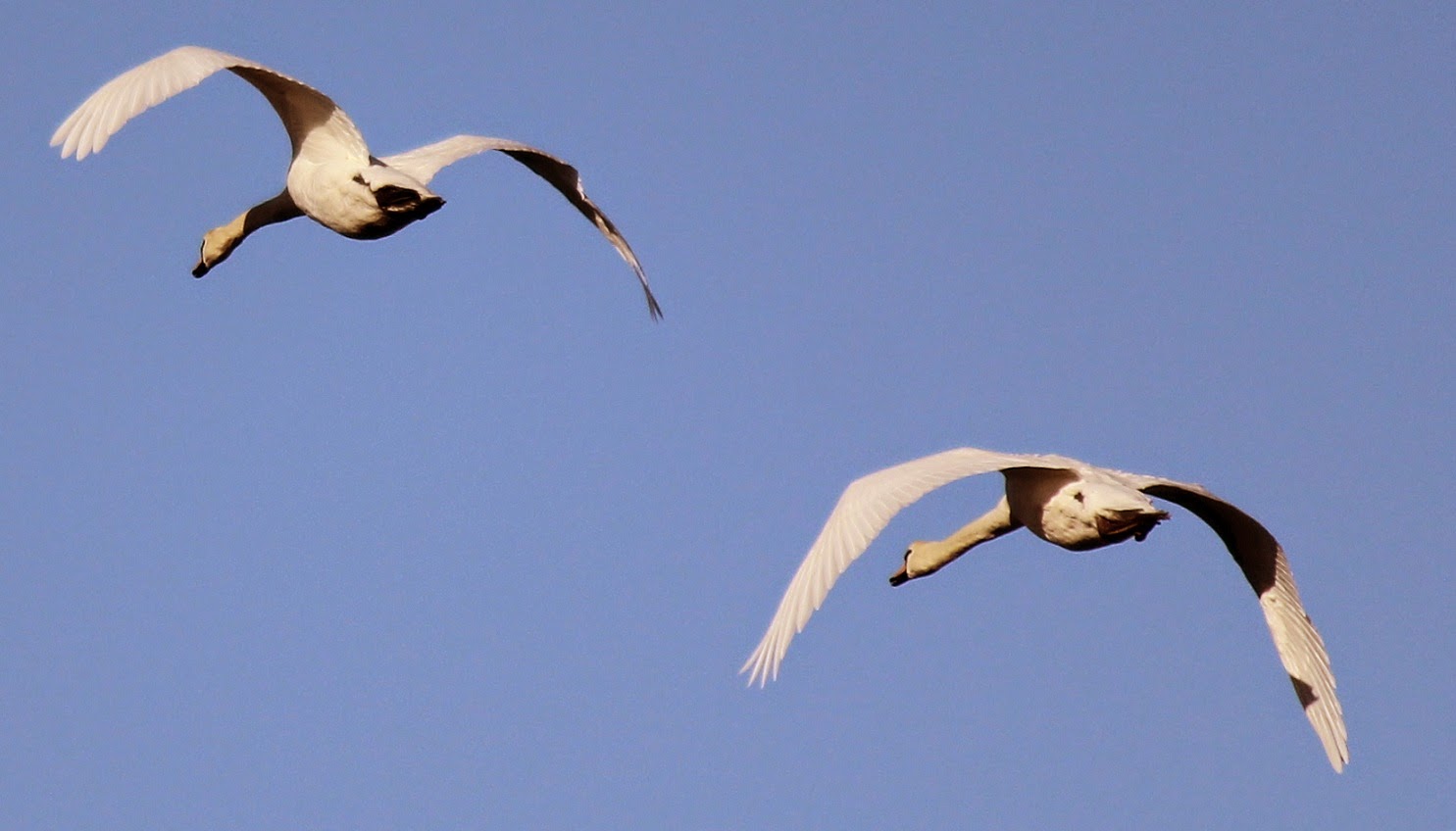
I snapped this pair of Mute Swans flying over the river at Throop.

I think this really shows off the majesty of the Grey Heron, but it's very overexposed. Still learning I'm afraid.

Sometimes you get the best shots when you least expect it. This Mallard was coming in to land right in front of me and made for a very comical image.

Swallows are difficult birds to capture as they're so fast and graceful. I'm pleased with this one though.

I quite liked this image as it's a surprisingly clumsy look for an otherwise graceful bird.

You'll often get blur on a bird's wings but in the case of this Willow Warbler it gives a great sense of movement.