Showing posts with label green woodpecker. Show all posts

Sunday, 5 February 2017

Patchwork Challenge Trip 5 (05th February) 53 Birds

Pursuing Pintails

I'd already missed the first lot of Pintails that had appeared in January, so when Martin mentioned that he spotted more on his Saturday visit I knew I had to try and find them.

I arrived at Longham the following day at 8.20 and was greeted to a largely deserted car park and even fewer birds. A few blackbirds and carrion crows were wheeling around but it was otherwise quiet.

The island was pretty disappointing with just Cormorants to be seen.
Heading to the large island on South Lake where most of the exotics and waders are typically found I saw no sign of the Pintails, although I did spy what looks like the last two Great White Egrets (the other appears to have flown off now).

As I got to the back fields I saw that everything had flooded, pushing all the geese and swans further away than usual. I tried to scan the large groups with my bins, but it's a folly without a telescope so I gave up.

A Great White Egret and Grey Heron fishing.
I walked along the back of North Lake in the hope of spotting Water Rails but saw nothing other than one of the Egrets and a Grey Heron, a small number of Great Tit and a flock of around 17 Pochard. Other than that it was pretty quiet so I headed back to South Lake.

Halfway along the back of South Lake I saw the Pintails, they were right in the middle of the lake, so my shots are pretty poor, but you can still make out how dainty and charming they are.

Not the greatest of shots, but you can see how dainty these ducks are.
Other than the Pintails my walk was pretty uneventful with the only new bird being a Green Woodpecker that was flushed by a pair of joggers.

TOTAL BIRDS SEEN: 53

Monday, 1 September 2014

Week 20 31-08-2014 Birds Spotted: 5

Hooray, it's migrant time, one of the most interesting times for bird spotting.
To celebrate my birthday I decided to go to Arne as I heard that an Osprey was currently in residence there while it stocked up on reserves to get it back home. I went out eager and was not disappointed...

Osprey
Okay, I was disappointed because my shots are terrible :). I was fighting heat haze and an incredible long distance, so these shots are strictly record shots.
What an incredible bird though. It's huge in size, and has been a big success story for the RSPB, thanks to numbers continuing to increase in Wales and Scotland. It''s also started breeding in England, supported by large stretches of water. It feeds primarily on fish and is famed for grabbing them, in its long powerful talons. Unfortunately this one was quite happy to spend all his time on a feeding station, meaning I didn't get to see it fly. It's unclear how long it will stay in Arne, (it's residing on Midllebere Lake) so I feel lucky to have spotted it, even if my pics aren't the best.
Not the greatest shot but you can clearly make out the white head and underbelly.

Another shot of the Osprey from the Canon 400mm

And one using my powershot SX50.

Whimbrel
I uploaded about 12 photos of suspected Whimbrels to Birdforum.net. So a big thanks to Nutcracker for confirming the one I suspected to be this rare migrating bird. It typically breeds in Scotland each year, flying through during the sping and winter. It's identified by darker wings, a slightly shorted bill and (this is my own personal identification tag) a more serious look than the Curlew. Up to 500 pairs breed each year, but it's still on the RSPB's red list. Like the Curlew it eats molluscs, invertebrates and even tackles crabs. If you don't leave in Scotland or the Orkney islands then you need to get lucky and hope one flies through your local patch.

It's call is a good way to identify the Whimbrel. The head markings are quite distinctive too.

And another passing shot, making it a little easier to identify.


Here's a Curlew for comparison. Look how happier and lighter it looks.

Greenshank
This is another migrating bird that is typically seen on passage. I knew it was about due to its piercing call, which is impossible to mistake. Unfortunately I couldn't see any on the ground, but managed to get a couple of shots in flight. Again, they're not perfect, but do identify this wader. It gets its name thanks to its long green legs and is a medium-sized, fast-flying wader. This one is possible a passage bird, but they do apparently winter in the area according to the RSPB's website.
You can just about make out its legs in this shot!
A better shot of its distinctive white rump.

A second bird I saw a little later.

Teal
This was an absolute piece of luck. I didn't notice the ducks until I enhanced the photo in lightroom. Even if I had saw them first time around eclipse plumage meant I wouldn't have recognised them. Teal are small dabbling ducks, typically found all year around in most parts of the country. During the summer males have very distinctive chestnut heads with green eye stripes, but they're not seen in this shot. Most of the North Wintering popular from Europe is found in the UK, so the RSPB has awarded it amber status.
I was looking at the Egrets and didn't see the Teals fly past.

Sandwich Tern
I've already spotted Common Terns, so it was nice to get this one before it headed home for another year. It's another amber status bird, with small breeding populations in certain parts of the UK. One such site it Brownsea island where these birds must have come from. I saw a juvenile and an adult. You can recognise them over other terns due to their black bills which finish with a yellow tip. Around 12,000 pairs breed in the UK and it can be seen from March to September, meaning these must be soon flying home.
Here's an adult Sandwich Tern.

Diving for some tea.
The young wasn't having as much success.

Another shot of the adult. Lovely bird.

So that's it for another week and I felt like it's been a good one. I am now up to 108 birds with 164 left to find. Something tells me it's going to start getting tougher!

Redshank looking for food.

A Stonechat was having a fight with an unidentified warbler.

Little Egrets were flying.


Swallows were still flying around as well.

With this one being particularly acrobatic.
A Vulcan from the air show that was on in Bournemouth.
More planes I don't recognise.

A flock of Redshanks.

A flock of Curlew.

Curlew were everywhere.
Eating crabs...

Flying...
And pretending to be Whimbrels...

A fuzzy Buzzard via the Powershot.
Fuzzy Black-Tailed Godwits.
And a Green Woodpecker stopped by.

A possible Greyling Butterly.

Spoonbills. I need a tripod for stronger shots.
A shot to highlight how far away the Osprey was.
Possible Fallow Deer.

A Sika Deer.

A group of fuzzy Shelduck.

Sunday, 8 June 2014

Week 8 08-06-2014 Birds Spotted 1

It was another relatively quiet week for new birds, but a great week all the same for capturing interesting specimens through my lens. This is going to be my last blog before I upgrade to a new lens. I've deliberated hard about which one to go for, but the Canon 400mm prime looks to be the most sensible choice for me. I've grown quite fond of taking bird in flight shots, and this particular Canon is much better than the zoom equivalent. You'll hopefully see an upgrade in my images very soon.

In the meantime lets take a look at what happened this week. In fact, let's look at the one new bird I saw.

Green Woodpecker
What an amazing looking bird. We went to Queen's Park Golf Course as I've often seen this gorgeous looking birds there in the past. They love flying down onto the greens where they have easy access to insects and can be quite hard to see due to their colouring. After hanging around the large pond there we walked off-course and eventually spotted one quite some way off in the distance. While they are immediately striking with their bright green plumage and red heads, it's their brilliant laughing calls that really give them away. This one was clearly excited as it was making quite a lot of noise. My first shot wasn't great as he was far away and on the ground, I was lucky enough to get a nice shot of it in flight though. Woodpeckers have bounding flight paths that can make them quite tricky to shoot, so I'm quite pleased with the way it eventually turned out. Also known as the yaffle (due to its laughing call) the Green Woodpecker is our largest woodpecker with over 52,000 breeding pairs. It's always nice when you go out with the hope of seeing something and have it actually happen and while it was the only new bird I spotted this week it was certainly worth seeing.

As you can see, they're well camouflaged when they are on the ground.

And here he is in flight, look at the gorgeous patterns on the wings.

So I only saw one bird this week, which puts my grand total on 55 birds, with just 217 left to spot. A near miss this week included a Bullfinch. I got a photo, but it's terrible quality, so I won't be including it here. Maybe I'll get it next week, along with that pesky Peregrine.

So to finish off this week here's a selection of birds and insects that I saw while visiting the pond and the Throop part of the river Stour.

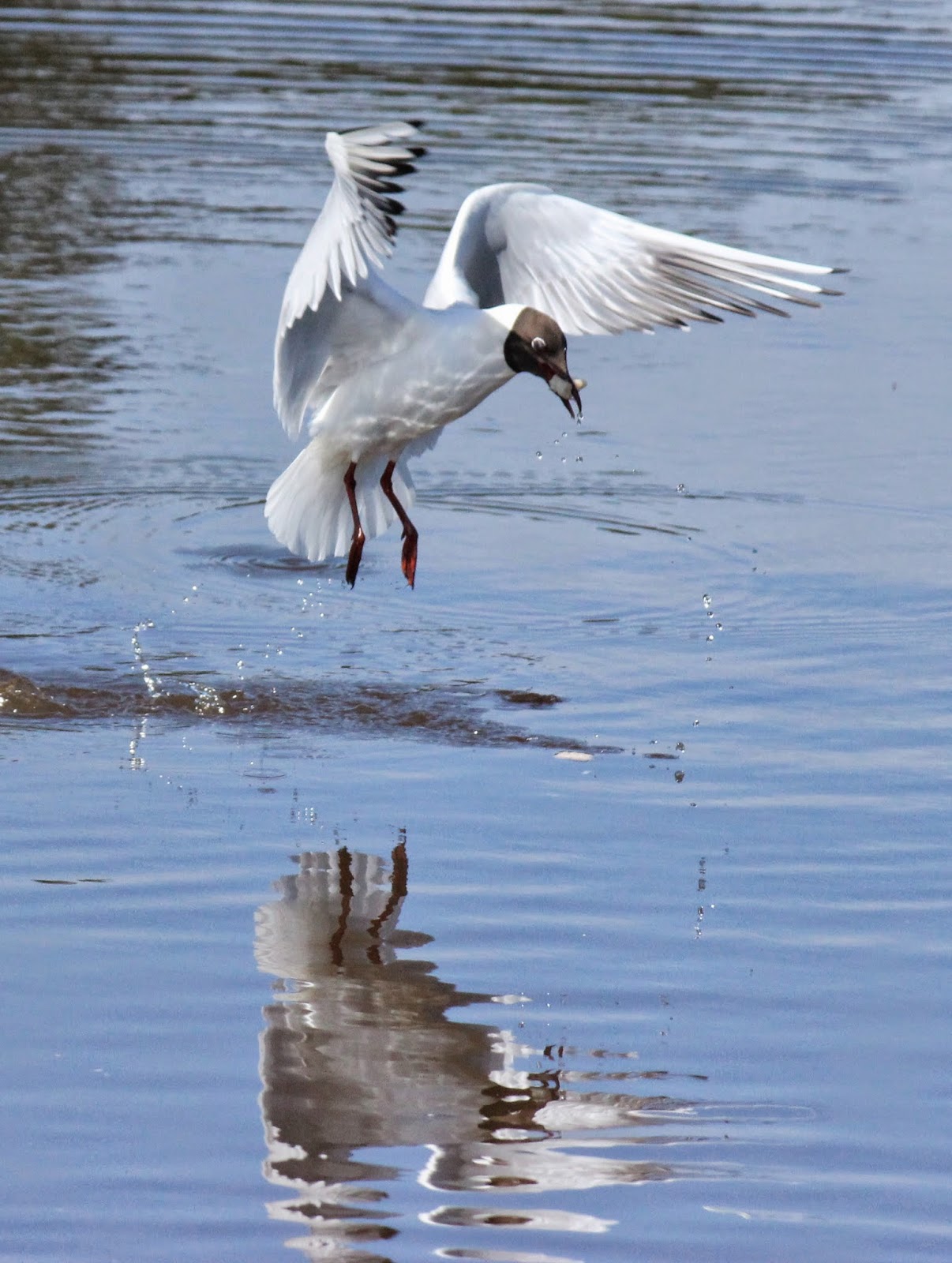
Even the most mundane birds look great in flight, as this Black-Headed Gull proves.

There were a family of Mallards at the pond. Lovely.

They weren't keen on getting wet though.

You certainly don't expect to see 10-inch Terrapins in the UK!

A male Mallard showing off.

A Mistle Thrush in flight.

The obligatory Robin shot.

A resting Damselfly.

A Black-Headed Gull splashes down.

A male Moorhen looking out for his chicks.

He got chased off by a duck though.

Annoyingly this Grey Heron was in a very shaded and dark area.

An opportunistic Black-Headed Gull.

I don't recognise this Damselfly, but it had a strange fluttering flight like a Butterfly.

A very tatty Red Admiral.

Hungry fish!

Hoverfly.

A final Black-Headed Gull flyover.