Showing posts with label sika deer. Show all posts

Monday, 1 September 2014

Week 20 31-08-2014 Birds Spotted: 5

Hooray, it's migrant time, one of the most interesting times for bird spotting.
To celebrate my birthday I decided to go to Arne as I heard that an Osprey was currently in residence there while it stocked up on reserves to get it back home. I went out eager and was not disappointed...

Osprey
Okay, I was disappointed because my shots are terrible :). I was fighting heat haze and an incredible long distance, so these shots are strictly record shots.
What an incredible bird though. It's huge in size, and has been a big success story for the RSPB, thanks to numbers continuing to increase in Wales and Scotland. It''s also started breeding in England, supported by large stretches of water. It feeds primarily on fish and is famed for grabbing them, in its long powerful talons. Unfortunately this one was quite happy to spend all his time on a feeding station, meaning I didn't get to see it fly. It's unclear how long it will stay in Arne, (it's residing on Midllebere Lake) so I feel lucky to have spotted it, even if my pics aren't the best.
Not the greatest shot but you can clearly make out the white head and underbelly.

Another shot of the Osprey from the Canon 400mm

And one using my powershot SX50.

Whimbrel
I uploaded about 12 photos of suspected Whimbrels to Birdforum.net. So a big thanks to Nutcracker for confirming the one I suspected to be this rare migrating bird. It typically breeds in Scotland each year, flying through during the sping and winter. It's identified by darker wings, a slightly shorted bill and (this is my own personal identification tag) a more serious look than the Curlew. Up to 500 pairs breed each year, but it's still on the RSPB's red list. Like the Curlew it eats molluscs, invertebrates and even tackles crabs. If you don't leave in Scotland or the Orkney islands then you need to get lucky and hope one flies through your local patch.

It's call is a good way to identify the Whimbrel. The head markings are quite distinctive too.

And another passing shot, making it a little easier to identify.


Here's a Curlew for comparison. Look how happier and lighter it looks.

Greenshank
This is another migrating bird that is typically seen on passage. I knew it was about due to its piercing call, which is impossible to mistake. Unfortunately I couldn't see any on the ground, but managed to get a couple of shots in flight. Again, they're not perfect, but do identify this wader. It gets its name thanks to its long green legs and is a medium-sized, fast-flying wader. This one is possible a passage bird, but they do apparently winter in the area according to the RSPB's website.
You can just about make out its legs in this shot!
A better shot of its distinctive white rump.

A second bird I saw a little later.

Teal
This was an absolute piece of luck. I didn't notice the ducks until I enhanced the photo in lightroom. Even if I had saw them first time around eclipse plumage meant I wouldn't have recognised them. Teal are small dabbling ducks, typically found all year around in most parts of the country. During the summer males have very distinctive chestnut heads with green eye stripes, but they're not seen in this shot. Most of the North Wintering popular from Europe is found in the UK, so the RSPB has awarded it amber status.
I was looking at the Egrets and didn't see the Teals fly past.

Sandwich Tern
I've already spotted Common Terns, so it was nice to get this one before it headed home for another year. It's another amber status bird, with small breeding populations in certain parts of the UK. One such site it Brownsea island where these birds must have come from. I saw a juvenile and an adult. You can recognise them over other terns due to their black bills which finish with a yellow tip. Around 12,000 pairs breed in the UK and it can be seen from March to September, meaning these must be soon flying home.
Here's an adult Sandwich Tern.

Diving for some tea.
The young wasn't having as much success.

Another shot of the adult. Lovely bird.

So that's it for another week and I felt like it's been a good one. I am now up to 108 birds with 164 left to find. Something tells me it's going to start getting tougher!

Redshank looking for food.

A Stonechat was having a fight with an unidentified warbler.

Little Egrets were flying.


Swallows were still flying around as well.

With this one being particularly acrobatic.
A Vulcan from the air show that was on in Bournemouth.
More planes I don't recognise.

A flock of Redshanks.

A flock of Curlew.

Curlew were everywhere.
Eating crabs...

Flying...
And pretending to be Whimbrels...

A fuzzy Buzzard via the Powershot.
Fuzzy Black-Tailed Godwits.
And a Green Woodpecker stopped by.

A possible Greyling Butterly.

Spoonbills. I need a tripod for stronger shots.
A shot to highlight how far away the Osprey was.
Possible Fallow Deer.

A Sika Deer.

A group of fuzzy Shelduck.

Sunday, 18 May 2014

Week 5 18-05-2014 Birds Spotted 3


I was working on a photography project this week so it was a good opportunity to head to Arne again and take a gander around. Unfortunately, as I was specifically looking to capture certain animals I ended up seeing hardly anything new.

It's not too much of an issue though as Arne is a fantastic place to visit and I met up with plenty of fellow bird watchers who gave me great tips on where to head out in the following few weeks. Let's just say that I should be able to add quite a few more birds to my list very soon.

Anyhow, let's take a look at what I did spot this week.

Kestrel
There's a pair of Kestrels breeding in the barn at Arne, but the wardens there are concerned that the eggs aren't going to hatch, which is always hard to hear. Anyway I was walking in the complete opposite direction of the barn and was alerted to a cry overhead. While the sun made it difficult to see clearly, its unmistakable tail markings and ability to hover in one place meant that the Kestrel was easily identifiable.
It's a cracking looking falcon, and one of our most prolific, with over 46,000 breeding pairs. It's found all over the UK, and is a regular site over motorways, where the busy traffic disturbs the numerous small creatures that the Kestrel loves to feed on.

Kestrel is flight.
A slightly blurrier image showing its distinctive tail feathers.

Mistle Thrush
I've already seen a Song Thrush, so it was lovely to add its bigger cousin to my list. I caught this one as I was heading back to the car park. It was singing its heart out in a tree over my head and was more than happy to show off its impressive voice.
It's a larger thrush compared to the Song Thrush and a lot more stockier. It holds itself more upright when walking on the ground as well, making it that little bit easier to identify. Like the Song Thrush its numbers have been on the decline, but it's still widespread across the British Isles with over 170,000 breeding territories recorded.


Meadow Pipit
Just one more bird for me this week, but it's a good one and one that I've not seen before. I've been actually training myself to seek out birds by listening to their calls (as you can imagine it's incredibly useful) and this helped me track down this little fellow. Knowing bird calls is also handy when you have birds that are very similar to each other (gulls and warblers being the best examples) so I'm going to carry on practising.
Anyway this Meadow Pipit was singing from a nearby gorse, and hung around long enough for me to confirm its voice on an app I've got (modern birdwatchers have it easy). It's quite similar to the Tree Pipit and is a similar size to the House Sparrow. It's an extremely common heathland bird, with over 2 million breeding pairs.

So that's it for this week. Not the most exciting of weeks in terms of new species, but I did manage to spy quite a few familiar birds as I went on my four hour walk. I discovered a whole new side of Arne, with another lake that's apparently a great spot for Spoonbills, and while I heard a Cuckoo, I'm not sure I actually spotted one. I did in fact get one more bird, but as I'm currently unable to identify it, I'm not going to include it. Anyway, here's some of the other things I spotted on my Saturday trip.

This Blue Tit was using one of the many nest boxes that had been set up by park wardens.


This tiny little Blue Tit flew down to the ground and couldn't work out how to get out of his predicament. I watched him for a good 10 minutes with his parents giving him support. He eventually made it to a nearby hedgerow where his parents fussed over him.

And here's one of the parents in question. I stayed back as far as I could as I didn't want to agitate them. People were passing by oblivious, which just goes to show what you can miss if you don't look around you.

There's something rather dashing about male Blackbirds, so I was pleased to see this little fellow.

You have to be patient with animals. I waited for about 15 minutes for this deer to look up from its feeding. It's obscured by the grass, but still makes for an interesting shot.

While I prefer birds, I'm not adverse to snapping the odd insect. This dragonfly was a nightmare to catch on the wing, so I waited a good few minutes for him to land.

I'm not happy if I don't get to shoot a Robin, so thank goodness that this one strayed into my viewfinder.

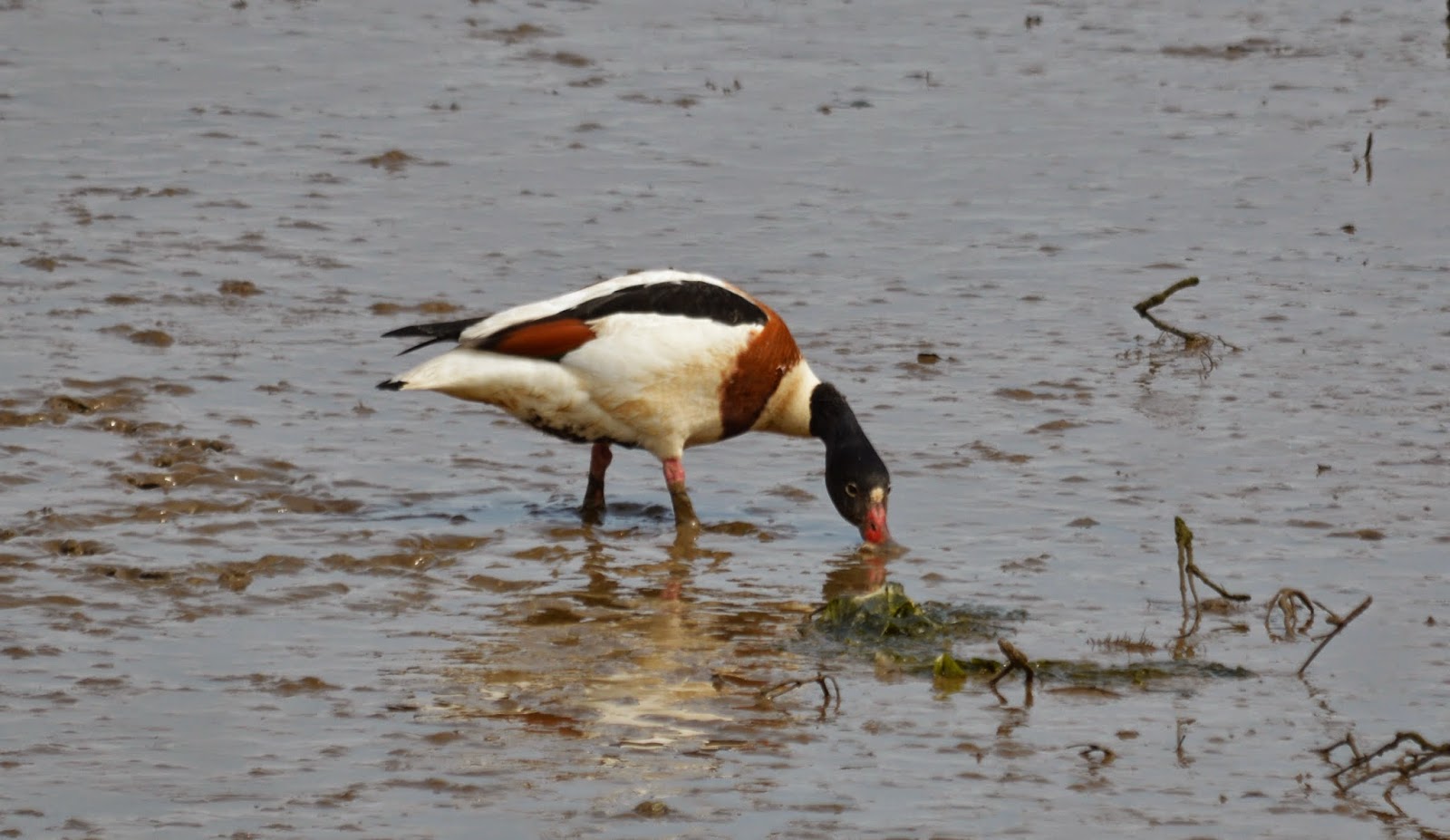
The amount of noise this Shelduck was making was incredible. A really loud slurping as it sifted through the water for food. Noisy little duck.

I spied this Jackdaw looking for grubs. 

This Grey Squirrel was at the feeding station scaring off the birds. Grrrrrr. He looks lovely though so I won't hold it against him too much.

Most people think Magpies are black and white. Those people are wrong.

Just as I was getting into my car a Greater Spotted Woodpeaker headed to the feeder. I couldn't get a great shot, but luckily I've already seen one.

So that's another update over and done with. I've now spotted 51 birds and have another 221 to find.